Telecom Acronyms You Should Know

35 Business Telecom Abbreviations You Should Know when Talking to your Service Provider
(2026 Update)
Ever been on the phone with your business internet or phone provider and realize halfway through the conversation that you start wondering when the person on the phone started speaking a different language? The conversation starts out innocent enough with “high speed internet” and “phone”; those we understand just fine! Somewhere along the way it takes a wild left turn and now we’re talking about PRI … PBX … DID … DIA – wait what??
Fear not – just bookmark this post and return to it whenever you hear an acronym you might not be sure of. We’ll cover the basics here, so that you’re armed with the right tools and information to have an honest discussion with your service provider.
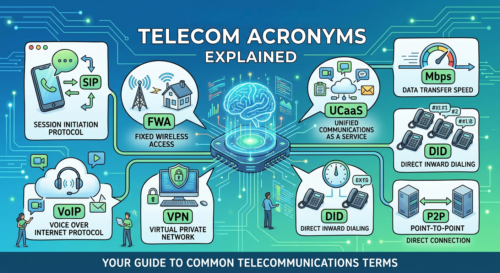
1. Broadband:
High speed internet access delivered via fiber, cable, fixed wireless (5G FWA), or satellite. Modern broadband standards require significantly higher speeds than older DSL and copper-based services. Think of “broadband” the way people think of “transportation”—it’s the category, and fiber/5G/cable are the vehicles.
2. CCaaS – Contact Center as a Service:
Cloud platforms for voice, chat, SMS, social, and AI-driven customer interactions.
3. DIA – Dedicated Internet Access:
Business-grade internet with guaranteed bandwidth and service level agreements (SLAs).
4. DID – Direct Inward Dialing:
Individual phone numbers assigned to users or departments.
5. DSL – Digital Subscriber Line:
Legacy copper-based broadband, now largely replaced by fiber, cable, and 5G.
6. E-911 / NG911 – Enhanced and Next-Generation 911:
Emergency services supporting accurate location and IP-based communications.
7. EoC – Ethernet over Copper:
Legacy Ethernet delivered over bonded copper pairs; largely phased out.
8. eSIM – Embedded SIM:
Digital SIM technology used for mobile devices and IoT deployments.
9. Fiber / FTTP / FTTC / FTTN:
Modern fiber deployments delivering high-speed, low-latency connectivity.
10. FWA – Fixed Wireless Access:
5G-based wireless internet used as primary or backup connectivity.
11. IP – Internet Protocol:
Standard for routing data across networks; foundational for VoIP, cloud apps, and unified communications.
12. ISP – Internet Service Provider:
Any company, business or organization that provides access to the internet itself or services provided through the internet. Familiar ISPs include Verizon, ATT, CenturyLink and Comcast (to name a few).
13. ISDN – Integrated Services Digital Network:
Legacy digital telephony. Still referenced for PRI circuits, though widely phased out by carriers.
14. IVR – Interactive Voice Response:
Automated call routing and self-service phone systems.
15. LAN – Local Area Network:
Internal business network connecting devices within a location.
16. Latency:
The time it takes data to travel from source to destination; critical for VoIP, video, and cloud applications.
17. LEC / CLEC – Local Exchange Carrier / Competitive Local Exchange Carrier:
Incumbent versus competitive telecom providers.
18. LTE / 5G / 5G SA (Standalone):
Mobile broadband technologies; 5G SA enables ultra-low latency and advanced enterprise use cases.
19. MAC Address – Media Access Control Address:
A unique hardware identifier assigned to network interfaces.
20. Mbps / Gbps – Megabits / Gigabits per second:
Standard units for measuring internet bandwidth.
21. P2P – Point to Point:
A type of connection, either virtual or physical, that directly connects two devices (locations).
22. PBX – Private Branch Exchange:
A business phone system. Modern PBXs are often cloud‑based (Hosted PBX / UCaaS).
23. POTS – Plain Old Telephone Service:
Analog copper phone lines being decommissioned and replaced with VoIP or wireless alternatives.
24. PRI – Primary Rate Interface:
Legacy digital voice trunking originally delivered over T1 copper; often emulated over fiber or SIP today.
25. PSTN – Public Switched Telephone Network:
The PSTN is the telephone cloud that we are all familiar with. It’s the large interconnection of carrier networks that allow people to make phone calls to each other from anywhere in the entire world. Traditional phone network transitioning to all-IP infrastructure.
26. QoS – Quality of Service:
Network traffic prioritization to ensure voice and video performance.
27. SASE – Secure Access Service Edge:
Combines SD-WAN and cloud-based security into a unified architecture.
28. SD-WAN – Software-Defined Wide Area Network:
Intelligent, application-aware WAN routing that often replaces MPLS.
29. SIP – Session Initiation Protocol:
The signaling protocol behind VoIP, UCaaS, and SIP trunking.
30. T1:
A legacy, business‑grade digital circuit that delivers symmetrical bandwidth over dedicated copper pairs using time‑division multiplexing (TDM). A single T1 contains 24 separate 64 kbps channels, originally designed to carry multiple phone calls or a mix of voice and data.
31. UCaaS – Unified Communications as a Service:
Cloud-based calling, messaging, video meetings, and collaboration.
32. VPN – Virtual Private Network:
Encrypted connections for remote access or site-to-site networking.
33. VoIP – Voice over Internet Protocol:
The modern standard for business voice communications.
34. Wi-Fi 6 / Wi-Fi 6E / Wi-Fi 7:
Modern wireless standards with higher capacity, speed, and lower latency.
35. Zero Trust:
A security framework requiring continuous verification of users, devices, and applications.